If you think 4K TVs are impressive, wait until you hear about 16K TVs. These are the latest and most advanced displays on the market, boasting a resolution of 15,360 x 8,640 pixels, which is 16 times more than 4K and eight times more than 8K. With such a high pixel density, 16K TVs promise to deliver unparalleled clarity, sharpness and realism. But are they really worth it? And when will they become mainstream?
What Is 16K TV?
The term 16K refers to the number of pixels in an image. Pixels are tiny dots that make up the picture on a screen. The more pixels there are, the more detail and quality you can see. For comparison, a typical 4K TV has a resolution of 3,840 x 2,160 pixels, while an 8K TV has a resolution of 7,680 x 4,320 pixels. A 16K TV has a whopping resolution of 15,360 x 8,640 pixels, which amounts to over 132 million pixels in total.

Because pixels have to be smaller to fit so many into one display, individual pixels can’t output as much light either. That’s why it’s crucial for 16K TVs to offer a high brightness level. The standard for 16K TVs is 1,000 nits, which is the same as some of the best projectors on the market. A high brightness level ensures that the picture is vivid and vibrant, even in bright environments.
Another important feature of 16K TVs is the frame rate, which is the number of times the image changes per second. A higher frame rate means smoother motion and less blur. The standard for 16K TVs is 120Hz, which is twice as fast as most 4K TVs and four times as fast as most HD TVs. A high frame rate also reduces eye strain and fatigue, making the viewing experience more comfortable and enjoyable.
Who Makes 16K TVs?
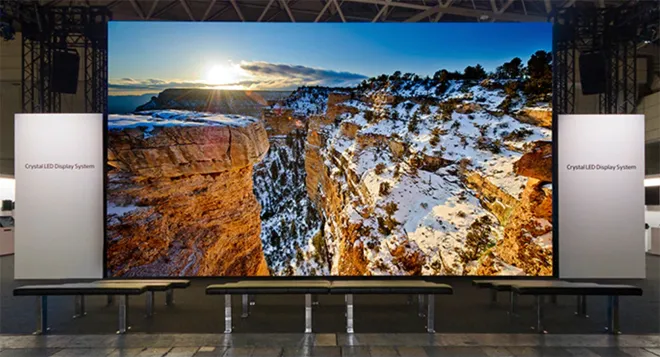
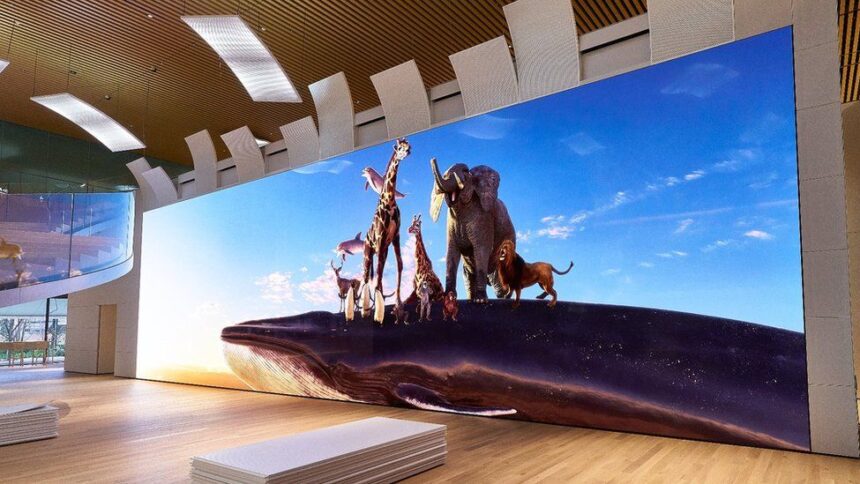
The first company to unveil a 16K TV was Sony, back in 2019. Their 16K Crystal LED display was a thing of beauty, with a modular setup that enabled it to create a ‘quasi-virtual’ reality that delivered immersive viewing. The display consisted of 16×18 inch square panels, each with a resolution of 360 x 360 pixels. The panels could be arranged in different configurations, depending on the size and shape of the space. The display also had a 99% black surface area, allowing for deep blacks and excellent contrast.
However, Sony’s 16K TV was not meant for consumers, but for commercial buyers. The display was installed in a research center in Japan, where it was used for scientific and medical purposes. The price of the display was not disclosed, but it was estimated to be in the millions of dollars.

The first company to unveil a consumer-oriented 16K TV was BOE, a Chinese display maker. Their 110-inch 16K TV was shown off at SID Display Week 2023 in Los Angeles, to celebrate BOE’s 30-year anniversary. The display was made of one single screen, rather than modular panels, and had a contrast ratio of 1,200:1 and a color gamut of 99% DCI-P3. However, the display also had some drawbacks, such as a low brightness of 400 nits, a low frame rate of 60Hz, and a messy array of 16 DisplayPort cables needed to connect it to a source.
The BOE 16K TV was also not available for purchase yet, as it was still a prototype. The price and release date were not announced either, but it was expected to be very expensive and very limited.
What Are the Benefits and Challenges of 16K TVs?
The main benefit of 16K TVs is the incredible level of detail and realism they offer. With such a high pixel density, you can see every nuance and texture of the image, even if you sit very close to the screen. You can also enjoy a wider viewing angle, as the pixels are less visible from different angles. Moreover, you can experience a more immersive and lifelike viewing experience, as the image fills your field of vision and creates a sense of depth and dimension.

However, there are also some challenges and limitations associated with 16K TVs. One of them is the lack of content. There is very little content available in 16K resolution, as most studios and broadcasters still produce content in 4K or lower. Even 8K content is very rare and hard to find. Therefore, most of the content you watch on a 16K TV will have to be upscaled, which means artificially enhanced to fit the higher resolution. This can result in a loss of quality and fidelity, as well as artifacts and noise.
Another challenge is the bandwidth and storage. 16K content requires a lot of data to be transmitted and stored, which can pose a problem for streaming and downloading. For example, a 16K video at 120Hz would require a bandwidth of about 120 Gbps, which is far beyond the capacity of most internet connections and HDMI cables. Similarly, a 16K video would take up a lot of space on your hard drive or cloud storage, which can be costly and impractical.

A third challenge is the cost and availability. 16K TVs are very expensive to produce and buy, as they require advanced technology and materials. They are also very rare and scarce, as only a few companies make them and only in limited quantities. Therefore, 16K TVs are not accessible or affordable for most consumers, at least for now.